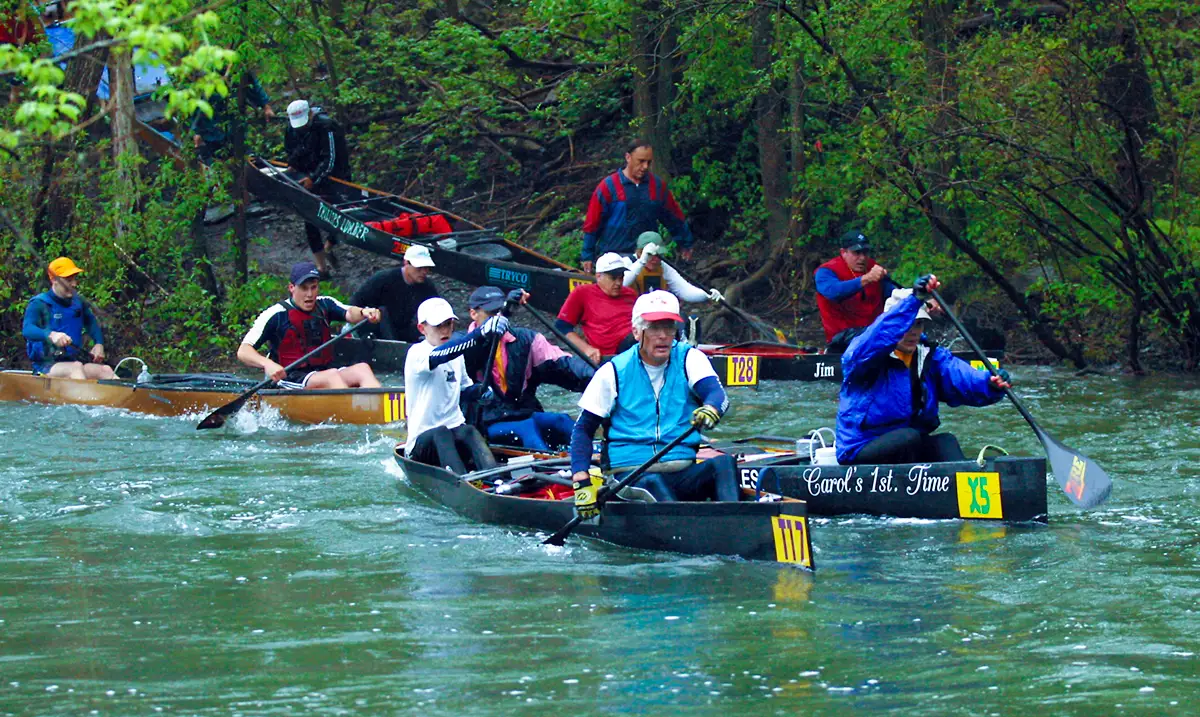
Each Canoe must have a pit crew (support team) to provide the races with fluids, nourishment, and encouragement throughout the 70-mile race course. You will need a minimum of 1-2 people to help pit each canoe. The job begins preferably a few days before the race. This allows the pit crew to practice a pit with the canoe team, learn the course and prepare food in advance.
It is recommended to arrive 1 hour before the race start with the paddlers. You may help the paddlers carry their canoe and equipment to Brookwood Point as you may have to park a ways from the start.
Ensure each paddler has a hat, paddles, sunscreen, life jackets, whistle, jug of fluids and other nourishment. Energy bars can be taped to the inside of the bow and canoe.
A support crew captain should be chosen and act as a leader for the team. Should a team drop from the race it is the responsibility of the crew captain or racers to report to the nearest time checkpoint or finish line to officially sign out of the race.
Paddlers should provide Pit Crew with the following:
● Cooler with jugs on ice. Each jug to contain about 2 liters of fluid. Plain water is not recommended alone as it does not replace electrolytes, however, it is a good idea to have water on hand for emergencies. Each jug should be labeled ahead of time (preferably, before adding fluids) with masking tape and a permanent marker. Each jug should have Paddler's name and place to receive jug (i.e., Start, Milford, Southside Dam, etc.). This makes life easier for pit crew and also can ensure if jug is lost in water, that the finder knows who to return the jug to later. Have 1 hose of each jug available in case other jugs are lost, and for cleanliness as hose may be dragged in river, mud, or left in bottom of canoe. Jugs are often a recycled 2 liter plastic soda bottle with a drilled cap for hose to fit and tape on each end of cap to keep hose from falling out of bottle. Typically, the hose is 6 foot long. Make sure when giving jug that hose is not siphoning out! This can be avoided by blowing down into the hose until you hear a bubbling sound. Keep hose lose so it doesn't get tangled up.
● A list of items each Paddler wants at each pit and recommended pit site.
● Food items (i.e., bananas, Ensure/Boost, power bars, power gel, mixed fruit, GU, Nutragrain bars, etc.)
●Extra supplies: Life jacket, whistle, 1-3 paddles, duct tape.
A pit is recommended every 2 hours and, depending on the weather conditions, may be more; especially, if there is a hot day as in 1999 when it reached 92 degrees.
A pit can be done by land or by canoe. Whichever way you go, be sure to have extra clothes, footwear, and towels available. If you are lucky enough to have an extra canoe, paddles, and life jackets, and have the capability to paddle, then this is the way to go. This saves the paddlers time. Paddling to the shore and out of the current slows the team down. Most of the top pro teams all have water pits with canoe pitting facing upstream. To do so effectively, practice is recommended.
By land or wading into the water is the other option. This can be touchy in some areas especially if the river is high. Be aware of fast currents and a quick drop in elevation. Watch other pitters if you are not sure where to stand and communicate with them so you don't get into each other's way.
DO NOT TOUCH PADDLES, CANOE, OR HELP THEM BY PUSHING THEIR CANOE, OR PICKING UP A PADDLE IF DROPPED.